
Expert Equine Care You Can Trust
Green Hills Veterinary Clinic offers comprehensive equine vet care services, customized for the needs of the individual, whether you raise horses for pleasure, work, or show. Consult with our veterinarians for your individual equine or herd wellness care needs.
Our Equine and herd wellness care services include:
- Vaccinations
- Equine reproduction
- Nutritional needs
- Equine lameness evaluations and treatment
- Equine dental care
- Preventive care for horses

Equine Lameness Evaluation
Foot care is of primary importance in equine care, and our veterinarians will perform lameness evaluations. At our clinic, we are able to offer a complete and thorough evaluation, including X-rays, to assess the source and course of treatment for this serious problem. Lameness can be caused by a variety of issues, including:
- Injury to bone, muscle, tendons, or ligaments
- Diseases
- Overwork
- Infection
- Neurological disorders
- Horse Hoof
- Farrier
- Horse Conformation
Physical examination and X-rays help pinpoint the area of lameness and guide us in treatment protocols and prognosis. Treatment may vary depending on diagnosis, but often includes rest, appropriate medication, and other supportive therapies. Consultation with our veterinarian is generally recommended, even for mild lameness, as it may worsen if not properly diagnosed and treated.
Equine Dental Care
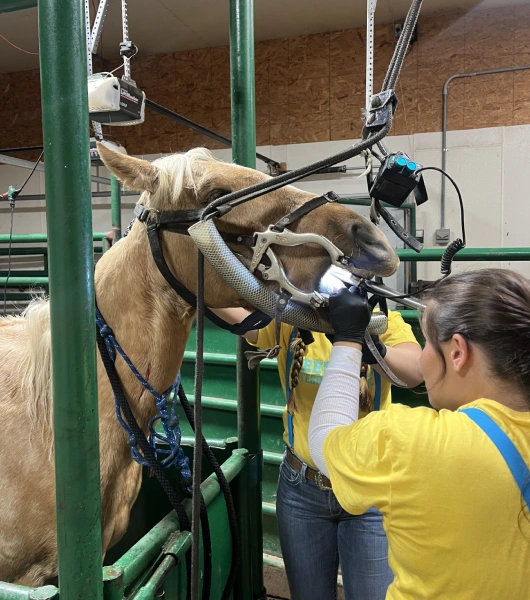
Our highly skilled doctors can take care of your equine’s teeth using our power float equipment. Our doctors recommend annual dental care. Don’t let mouth pain keep you and your mount from enjoying the ride!
Horse dental health is a unique discussion as horses’ teeth grow their whole life. So, the saying “a little long in the tooth” has some validity. We have a role in maintaining horses’ health by keeping the wear and growth even and appropriate. This is a procedure commonly known as “floating”. A simplistic explanation of “floating” is to grind or file the rough edges off the teeth to ensure the mouth stays comfortable. That really is too simple of explanation, however. What we must understand and do as veterinarians is not only keep rough edges off but ensure that the growth and wear is appropriate to match the physiologic motion of the jaws and teeth. The front teeth, or incisors, must have an even surface to pick the grass and the molars must have a good grinding surface to chew and swallow.
Dental Problems for Equines
One of the most common reasons for weight loss, especially in older horses, is a dental problem. This could include an infected tooth that needs to be extracted, or more commonly an uneven wear of the teeth. We see conditions with names like “ramps” or “hooks” or “wave mouth”, all of which describe an uneven wear on the teeth that needs correction over time. If a horse is diagnosed with one of these abnormalities, they may need veterinary dental care every few months to slowly correct the biomechanics of the teeth as well as the chewing motion to even out the wear on the tooth. It is strongly recommended to have annual veterinary exams on all horses and donkeys to avoid some of these dental problems and keep their teeth healthy and avoid the necessity for major dental work.
Equine Reproductive Services
Aside from basic herd healthcare, we offer extensive equine reproductive services, including artificial insemination and reproductive ultrasounds.
Equine Artificial Insemination
We provide equine artificial insemination services with cooled semen. Breeding mares with cooled semen requires that all parties involved – mare owners, stallion managers, and veterinarians – need to coordinate semen shipments with the mare’s ovulation before shipping semen.
Some Potential Items To Consider
- Cost of stallion collection
- Cost of preparing semen for shipment, number of collections provided per breeding, the cost of shipping by air, and how shipping containers must be returned
- Days of the week stallion is collected
- Times when stallion is unavailable
- Days notice stallion manager needs before semen shipment
- Latest time one can call to obtain semen
- Longevity of semen
- First cycle conception rate of the stallion
- Method of transport used
- Number of times mare can be bred if she does not conceive, according to the contract
First cycle conception rates tend to be slightly lower with shipped semen than with natural breeding. Cooled semen opens up increased opportunities for available stallions, decreases some risks, and eliminates transport of the mare to the stallion’s breeding facility. Artificial insemination does require more intense breeding management, and veterinary costs are higher. Mares need to be examined regularly and bred within 24 hours of ovulation. Using HCG can influence ovulation, although response can be variable between mares.
Equine Reproductive Ultrasound
The use of reproductive ultrasound for breeding evaluation, as well as insemination timing, can increase the likelihood of pregnancy in your brood mares. Pregnancy diagnosis can be performed at or around 15 days, post-insemination, giving sufficient time to reorder semen if needed.
The technology of reproductive ultrasound is safe and relatively low in cost, making it a necessary tool for the equine breeder. Green Hills Veterinary Clinic offers skill and experience in the use of reproductive ultrasound.